Remembering the Bright, Wild, All-Too-Brief Life of British Aristocrat
Lee Radziwill got to know Mark Shand in the late 1960s at Helmsley, the shooting estate in Yorkshire that her husband Prince Stanislas Radziwill leased with Harry Ashcombe, the younger brother of Mark’s mother. “I was always so happy when I knew Mark was coming,” she says. “It was so dreary when he didn’t.”
For a long time Shand assumed that he would inherit a substantial fortune from his thrice-married yet childless Uncle Harry (known as Mad Harry). The fourth Baron Ashcombe was chairman of Holland, Hannen Cubitts, which controlled the family’s vast property holdings in London. Unfortunately, as William Astor puts it, “he was the nicest man—and the worst businessman. He owned Pimlico and he sold it for nothing.” (According to The Telegraph, the Pimlico estate, covering 27 acres, including 480 houses, was sold for £4.4 million in 1970.)
Shand’s first job was as a porter at Sotheby’s. “Mark was allocated to come and work for me,” says Duncan McLaren, who was running the auction house’s new international division in the early 1970s. “He didn’t come in very often. And he never was going to be contained by four walls. I came upstairs one day and there he was chopping cocaine on my desk. And the senior director came in and asked, ‘Mark, what are you doing?’ ‘Oh, I’m separating talcum powder.’ The man believed him and walked out.” Shand was fired soon enough, however, when he and a fellow porter were caught in the packing room dressed up in rare 14th-century Japanese armor, dueling with samurai swords.
In 1971, Shand met Harry Fane, who would become his closest friend, business partner, and fellow explorer. “It was the beginning of an intense and legendary friendship which was to last 25 years,” Fane told me. “Little daunted us, and ‘Why not?’ was always a good enough reason to do something or go somewhere.” The Honorable Harry St. Clair Fane was the second son of the 15th Earl of Westmorland, who was lord-in-waiting to Queen Elizabeth II and later Her Majesty’s Master of the Horse. A year younger than Shand, he had just returned from his sheep-farm experience. The following year, Fane and Shand rented an apartment in New York, on East 73rd Street. Tall, handsome, aristocratic, and heterosexual in a decade when androgyny was all the rage, they were sought after by the city’s most fashionable hostesses. Diana Vreeland doted on them, as did Jackie Onassis. They were regulars at Mortimer’s and Elaine’s, Warhol’s Factory lunches and Studio 54’s basement. Willing models and heiresses were never in short supply—on either side of the Atlantic.
In 1975, when 18-year-old Caroline Kennedy enrolled in an art-appreciation course at Sotheby’s in London, the British tabloids were quick to link her to Mark. That November, People magazine reported that Shand dismissed the idea, “saying she is ‘too young.’ ” The rumors had started the previous month, after Caroline and Mark were photographed leaving Lady Anne Lambton’s party for Andy Warhol’s Philosophy book at five in the morning. (I remember Andy getting a call from Jackie, berating him for inviting her teenage daughter to “that kind of party.”) In his Diaries, Warhol wrote, “Mark Shand was Caroline’s first love. He swept her off her feet, then dropped her without a second thought.” William Astor told me, however, that Mark had brought Caroline to stay at Ginge Manor, the Astors’ country house, on several occasions, and he was sure they weren’t having an affair.
By 1979, the Daily Mail was asking, “Is this the sexiest man in London?” Playboy, however, was not a job description. “We were both at a loss as to what we were going to do for a living,” Harry Fane explained. “So we decided we would go into business selling objets d’art. We had no idea what objets d’art meant.” They launched their company, Obsidian, in 1978, and started out by trawling the Portobello Road for inexpensive silver candlesticks and antique clocks but soon graduated to Art Deco jewelry by Cartier and Van Cleef Arpels. Shand later wrote, “Like posh swagmen in linen suits, with sacks of beautiful booty over our shoulders, we hit the rich and famous, the old and new wealth in the money-drenched capitals of the Americas: Caracas, New York, Dallas, Houston, Los Angeles, Palm Beach, and Miami.” In 1980 they opened an office on Duke Street, near the London Ritz, where clients could come to them.
By then they were spending every February with Prince Jagat at his ancient fort in the center of Jaipur, hunting for gems by day and carousing by night. July and August were reserved for Bali, where they built, in Shand’s description, “a beautiful Robinson Crusoe house on a surfers’ beach. We lived a bohemian life, chilled-out and very anti-social.” Fane recalled, “We did some amazing trips. We did this huge sail through Indonesia in a dug-out tree.” But, Fane added, “Mark came to me one day and said, ‘Look, I really want to give up work. I want to spend my life out here, not back in the other world. Let’s sell everything and buy a boat.’ ”
Fane returned to work at the end of the summer while Shand spent the next nine months restoring a 28-foot yacht in Fiji. “Mark sold his flat in London,” Fane said. “He sold every single thing he had for this boat.” In March 1982, Mark, along with a more experienced local sailor, set out from Fiji, to Honiara, in the Solomon Islands, dropping anchor in the harbor just in time for a hurricane to hit. “The boat was like a bucking bronco,” Shand wrote. “I decided we had to get off, otherwise we were dead…. We both were cut to pieces, lacerated by the coral while being swept ashore…. The boat had no chance…. I saw her rise up once more, topple backwards, and snap in two like a matchstick. I was numb. My dream had ended. I had lost everything.”
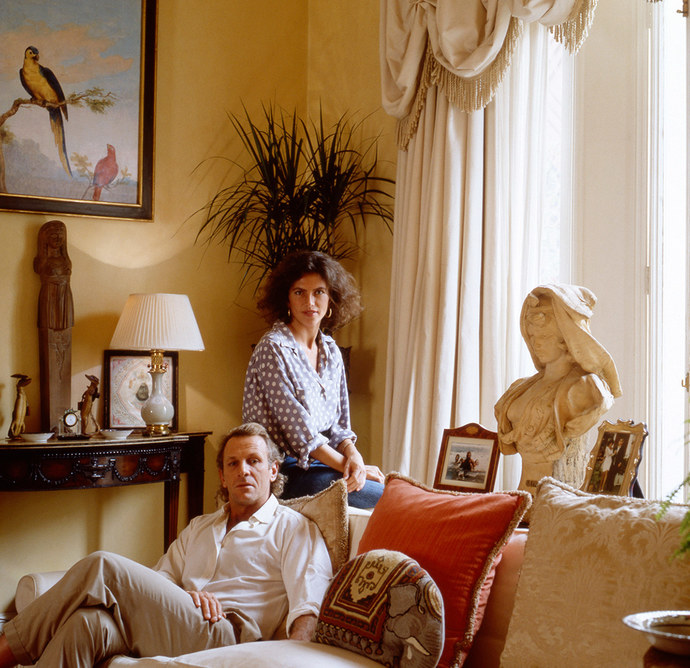
Shand and Clio Goldsmith, at home in London, 1998; they were married from 1990 to 2009.
Leave a Reply