Obama signs stopgap bill on spending
WASHINGTON — President Barack Obama signed legislation Friday keeping government agencies open into next week, giving White House and congressional bargainers more time to complete deals on taxes and federal spending.
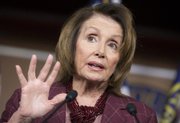
Enlarge
House Minority Leader Nancy Pelosi speaks out Friday on her differences with House Republicans over some parts of a final bud…
(By: J. SCOTT APPLEWHITE )
(Credit: AP)
Facing a deadline of midnight Friday, Obama signed the measure — which keeps government afloat through Wednesday — just hours after the House used a voice vote to send it to him. The Senate approved the bill a day earlier.
“Negotiations are at a snail’s pace. Glacial, in fact,” House Appropriations Committee Chairman Hal Rogers, R-Ky., told reporters. He said dozens of disputes remain.
“Everyone wants to tack something onto this bill,” Rogers said.
Talks over the environment, Syrian refugees, guns and dozens of other matters sprinkled across two major bills were likely to stretch at least into the weekend.
One bill provides $1.1 trillion to finance government for 2016; the other renews about 50 expiring tax cuts for businesses and individuals that, with additions, could swell to $700 billion in forgone revenue over 10 years.
The overall $1.1 trillion spending total was previously cemented in place, leaving only spending details to finalize. Republicans decided to avoid a shutdown fight with Obama by omitting provisions seeking to dismantle his 2010 health care law and halt funding for Planned Parenthood.
GOP lawmakers also attributed swift extension to new House Speaker Paul Ryan, R-Wis., who replaced John Boehner, R-Ohio, this fall. They said they needed to finish this year’s work and focus on passing election-year bills in 2016 highlighting GOP priorities on taxes and health care.
“There’s a honeymoon period in here,” Rep. Ted Yoho, R-Fla., said of Ryan’s recent ascension to the top House job. “And I think Paul’s articulated very well where we want to go.”
Leaders were hoping Congress would adjourn for the year next week after approving the two measures.
Republicans wanted to insert language into the bills ending the four-decade ban on U.S. oil exports and curbing Syrian refugees from entering the U.S., a response to last month’s deadly attacks in Paris. They also wanted to roll back legal curbs on the financial industry, prevent Obama from easing ties with Cuba and block his efforts to fight air and water pollution.
Though Republicans dominate Congress, the aversion of many GOP lawmakers to spending bills meant Democratic votes would be needed to pass the package.
Seeking to use leverage, House Minority Leader Nancy Pelosi, D-Calif., was threatening to withhold Democratic support unless Republicans agreed to annual inflation increases to a tax credit for children.
“Lifting the ban on oil [exports] and all of the money that means for the oil industry” without boosting the children’s tax credit is “too big, it’s unfair and it does not have the support of House Democrats,” Pelosi told reporters.
“But they have the majority and this is their vehicle,” she said, referring to the Republican House majority. “I wouldn’t vote for it and wouldn’t recommend anybody do that.”
Pelosi was also seeking more money for renewable energy and an end to curbs on federal research into gun violence, a matter that returned to the spotlight after last week’s mass shooting in San Bernardino, Calif.
No. 2 House Democratic leader Steny Hoyer of Maryland indicated on C-SPAN’s Newsmakers that Democrats could be open to bargaining on oil exports and gun-violence research. But he expressed opposition to an effort by Senate Majority Leader Mitch McConnell, R-Ky., to lift campaign-spending limits by party committees for candidates for federal office, saying, “I don’t want to say we can live with it.”
On the tax extensions, Republicans are pushing to make a number of business incentives permanent. Those include the business research and development tax credit, and a break that allows small businesses to take a larger depreciation allowance for an asset’s value during the first year after purchase.
Democrats, meanwhile, seek a permanent extension of the current Child Tax Credit, the Earned Income Tax Credit and the college-tuition tax credit, which are set to expire at the end of 2017. The tuition tax credit provides as much as $2,500 per student for people with adjusted gross incomes as high as $80,000 for individuals and $160,000 for families.
Among other items awaiting renewal is a sales-tax deduction that’s popular in Alaska, Florida, Nevada, South Dakota, Texas, Washington and Wyoming because those states don’t tax income.
Some Democrats want at least a 10-year extension of wind and solar tax breaks in exchange for lifting the ban on U.S. crude oil exports as part of the spending bill, Sen. Ed Markey, a Massachusetts Democrat, said Wednesday.
Also at issue is whether the spending bill will include a Republican proposal, opposed by Democrats, to block Syrian refugee resettlement in the U.S., as well as a plan backed by both parties to tighten the visa waiver program, which eases travel to the U.S. for some 20 million people a year.
Both issues became priorities after terrorist attacks that killed 130 people in Paris in November and 14 in San Bernardino on Dec. 2.
In another debate, House Majority Leader Kevin McCarthy and other California Republicans blamed Sen. Dianne Feinstein, D-Calif., for blocking a provision aimed at sending more water to the state’s farm belt amid a severe drought.
At a news conference, the Republicans said Feinstein abandoned a deal in which GOP lawmakers had conceded to Democratic demands, including protection of endangered species.
Feinstein said the language likely would have violated environmental law.
“I expect that by early next week we’ll have a bill that the state and federal government can sign off on,” Feinstein said in a statement.
Information for this article was contributed by Alan Fram, Erica Werner and Mary Clare Jalonick of The Associated Press and by Erik Wasson, Billy House, Roxana Tiron, James Rowley and Kathleen Miller of Bloomberg News.
A Section on 12/12/2015
Leave a Reply