Simon Property Group And Taubman: Divorcing Before The Honeymoon
This article was co-produced with Williams Equity Research.

The Many Roads Leading Here
“They say, timing is everything. But then they say, there is never a perfect time for anything.” Anthony Liccione
Simon Property Group (SPG) CEO, David Simon, would likely agree. Within days of the proposed $3.6 billion “mega merger” between Simon and Taubman Centers Inc. (TCO), two of the premier mall owners in the U.S., the coronavirus began sweeping through Italy and generating global headlines. Italy initiated what’s likely the harshest nationwide lockdown of any Western government in the post World War II era shortly thereafter.
Within three weeks of Italy’s lockdown, federal officials in the U.S. had initiated controversial travel bans and recommended similar measures. In total, 32 of 50 U.S. states had significant restrictions on citizens’ ability to congregate and open businesses by March 31.
With mall owners’ facilities effectively shuttered two weeks into March, coupled with widespread financial vulnerability in the apparel and movie sector, retail real estate’s struggles accelerated. Those dependent on large gatherings of people were the hardest hit: Malls, movie theaters, and theme parks.
Source: Yahoo Finance
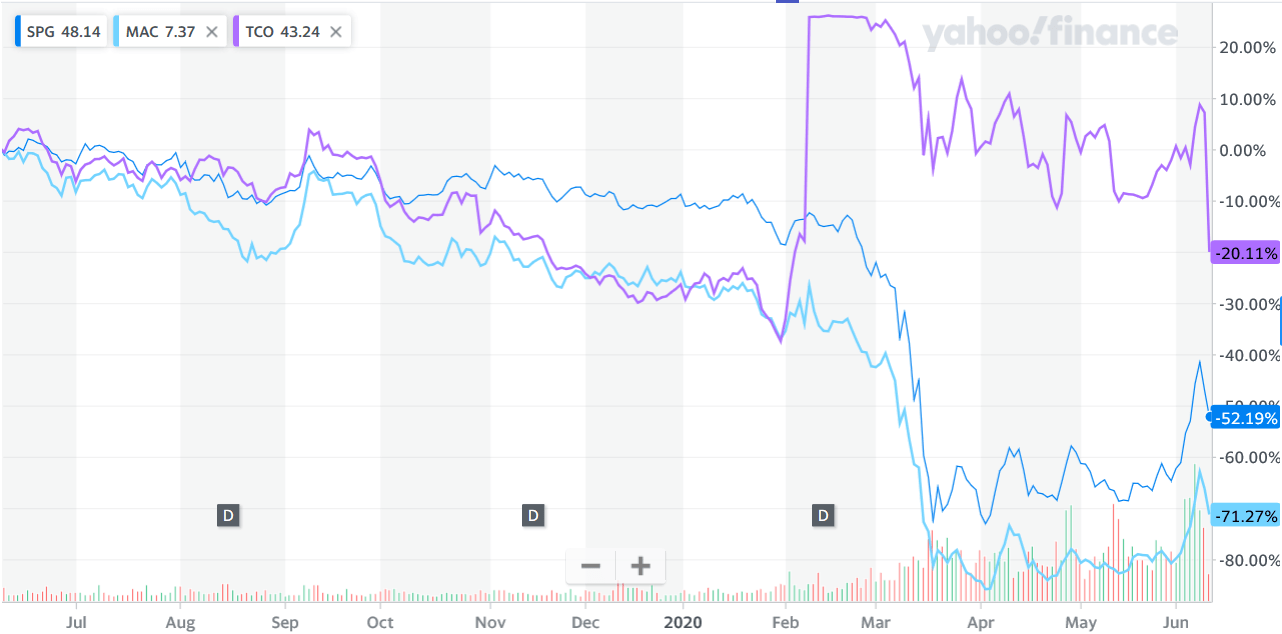
Simon and Taubman are shown alongside The Macerich Company (MAC) on a one-year stock chart. Simon was holding up considerably better than its two peers thanks to its much larger ($34.1 billion in total assets) and stronger (SP Credit Rating of “A,” tied for best in the REIT sector) balance sheet. Taubman’s spike in mid-February looked disproportionate, even for a buyout, before its peers Simon and Macerich declined by 50% and 70%, respectively, as government shutdowns and concerns surrounding the coronavirus reverberated throughout financial markets.
Foreshadowing Of Today’s “Surprise” Announcement
Despite a general consensus (which is often wrong) that the deal would close regardless of market conditions, the market began discounting the probability as demonstrated by Taubman’s stock falling well below the $52.50 agreement price.
Every day that the industry’s outlook darkened and the peer groups’ stock prices declined, the probability of Simon terminating the Taubman deal rose.
For those who invested the time to listen in on the Q1 conference call or read the transcript as we did, management commented on the subject twice. The first was in the customary fashion:
Let me turn to the Taubman transaction. As you know, we announced a transaction with Taubman on Feb. 10, 2020, and we will not make any comments or provide any updates on this call about the status of the Taubman transaction.
That “we will not make any comments or prove any updates on this call” didn’t exactly turn out to be the case.
After analyst Christy McElroy inquired about the desire to issue more long-term debt and any changes to that plan related to the Taubman purchase, David Simon, CEO, answered:
“OK. So, I have nothing to say on the further on Taubman. We’ll let you know when we have information to provide. So, there’s not much more I can say on that front.”
Another analyst asked a question involving Taubman later in the QA.
“Derek Johnston
OK. Understood, and thank you. So, a lot of investors are going to bring negative assumptions and speculation from your lack of commentary on the Taubman merger. So, without talking about Taubman at all, what would you say to those investors here and now directly?
David E. Simon
I said what I have to say, Derek.”
We were not the only market participants who noticed David’s tone. Within the constraints of the legal system, Simon told us as much as they could regarding their stance on the deal and it wasn’t optimistic. Simon had the option of providing positive commentary on the deal but chose not to. Like most areas of life, what people choose not to do can be as telling as what they decide to do.
Key Aspects Of The Contract and Simon’s Claims
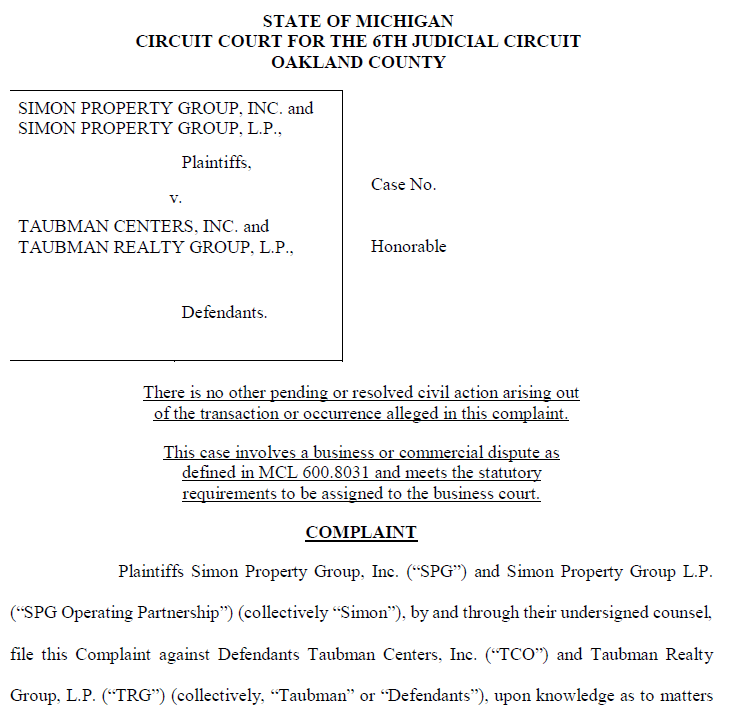
To start, the merger agreement for Simon to purchase 80% of Taubman has been appropriately described as “iron clad” by many research institutions. The following assessment of the agreement’s legal terms is strictly our opinion and should not be used to make a decision to buy or sell any security. We obtained a scanned copy of the complaint filed by Simon.
Source: State of Michigan
The contract has a “material adverse effects” clause, and to the average reasonable person, the pandemic and its externalities certainly seem to fit that description. We disagree. Pandemics are specifically excluded. Simon must convince a court that Taubman was disproportionately impacted by the coronavirus and its implications. Taubman closed its malls exactly one day after Simon and has already began opening stores in Asia where the coronavirus appears to have run its course. Taubman also reduced costs significantly. Per the formal complaint it filed, Simon argues they are justified as Taubman’s properties are:
“…uniquely vulnerable to the post COVID-19 retail environment for a multitude of reasons, including because they are primarily indoor properties that many consumers will avoid, are heavily dependent on a tourism industry that has been decimated, serve wealthy consumers who are now more likely to shop online and feature high-end upscale stores that are suffering heavily from the economic effects of the pandemic.”
Simon continues by claiming Taubman’s properties are more susceptible to the current crisis than its peers.
“The vast majority of Taubman’s properties are indoor malls in densely populated areas. Indoor malls account for more than 80% of Taubman’s properties and more than of its net operating income. Taubman’s competitors, in contrast, have far more open-air malls, outlet centers, strip malls and outdoor “lifestyle centers” or “power centers” featuring large retailers such as Home Depot and Target. As many financial analysts have observed, and as the superior performance of outdoor shopping centers during the pandemic already clearly demonstrates, the indoor malls that Taubman owns and operates are the last types of retail real estate properties that most consumers will want to visit on a long-term basis after COVID-19.”
We went through Simon’s claims line by line totaling nearly 40 pages. Simon’s argument is that the merger should be terminated under the material adverse effect, or “MAE” clause. Our non-legal and non-binding opinion is it is possible but unlikely that a court will consider the long list of complaints to reach the MAE standard.
An important caveat is that Simon has much deeper pockets than Taubman and has no problem spending a hundred million in legal expenses to either terminate the deal or renegotiate the purchase price lower. As demonstrated, Taubman’s stock is likely to fall another 50% from today’s 30%-40% drop if they are priced on a standalone basis. TCO’s management has a strong incentive to make some deal go through, even at a lower valuation.
Another clause often included in these types of deals is “force majeure” language where one or both parties can terminate the proposed deal because of unforeseeable events. That was not included in Simon’s proposed purchase of Taubman, and if it had, Simon would potentially have an easy out.
Now that we have a baseline understanding of the deal, we can accurately predict what Simon said in the press release prior to reading it.
Simon’s grounds to exit the agreement are two-fold.
- The coronavirus and associated government shutdowns had a “uniquely material and disproportionate effect on Taubman” compared to its peers.
- Taubman breached its obligations by failing to properly mitigate the impact of these related variables compared to industry peers.
Simon claims its target didn’t reduce costs and capex sufficiently compared to the rest of the industry. Predictably, at least for those with a fundamental understanding of the agreement, Simon did not justify terminating the deal based on the coronavirus itself, but rather Taubman’s response to it.
In terms of where the deal goes form here, a person “familiar with the matter” told MSN there are no discussions about renegotiating the transaction at a lower valuation. That is not mentioned in any of Simon’s public statements but we don’t put too much emphasis on this.
Simon has been trying to buy Taubman for nearly 20 years and there’s no reason it wouldn’t consider the assets attractive at a favorable valuation. It’s possible Simon wants to pay less, swap cash payments for SPG stock, or some combination.
Article VIII, Section 8 of the original agreement outlines the provisions and effects of terminating the deal. Specific penalties are associated with exiting agreement during the go-shop period, but that 45-day period is long gone.
Impact To Simon and Taubman’s Stock Prices
Taubman currently trades ~$35 per share compared to its pre- and post-deal price in the high $20s and low $50s, respectively. The corresponding market capitalization ranges from approximately $2.25 billion to $3.6 billion. These are important to keep in mind given Simon’s current market cap is ~$26.5 billion was above $50 billion earlier in 2020.
Taubman was never more than a strategic “bolt-on” to Simon’s 10x larger retail real estate empire. In our assessment, a major, if not primary, benefit was that Simon would end up owning the top dozen or so malls in the U.S. thanks to several trophy assets within Taubman’s portfolio.
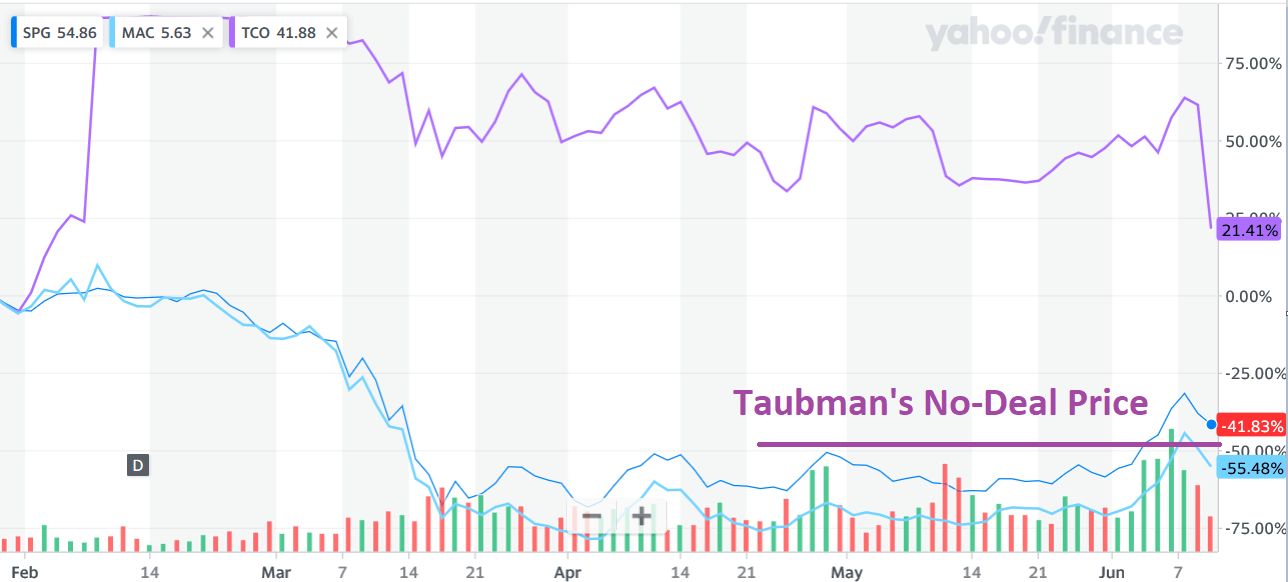
We can ascertain where Taubman is most likely to trade if the deal fully collapses via several methods. A direct comparison based on changes in stock prices can be performed with Taubman falling at the midpoint between Simon, the highest quality and most fortified player, and Macerich, a higher levered peer that still has considerable quality assets alongside a segment of lower performing properties.
Source: Yahoo Finance and WER
This corresponds with a -46.2% decline from Taubman’s 1/30/2020’s stock price or $12.94 per share.
Another strategy is applying cash flow multiples. This works similarly to our previous example as TCO has historically traded with valuations approximately in the middle of SPG’s and MAC’s.
Simon’s trades at a 10.1x forward multiple compared to Taubman and Macerich’s 14.9x and 4.6x respectively. Applying Simon’s multiple brings Taubman’s stock price down to $30.8 per share. The historically more accurate midpoint multiple of 7.4x or a stock price of $22.57. In case it’s not obvious, the specific multiples used and cash flow projections are immaterial to this analysis: It’s all on a relative basis and the assumptions behind the calculations are identical.
This exercise suggests TCO stock is likely worth $12.94 to $22.57 per share if the deal collapses assuming no penalty or benefit to Taubman. Concerning legal payments, and to make the math easy, each $100 million in cash paid from Simon to Taubman corresponds to a 3.6% increase in TCO’s market capitalization. If Simon is forced to pay Taubman $1 billion, TCO should move 35%-40% higher, all other things equal (note: REITs are valued on their balance sheet and future cash flow, a single cash payment received today will not increase future cash flows unless they are invested in cash flowing assets).
The situation is more complex for Simon although less significant. The maximum risk to Simon is the combination of significant legal expenses and compensation to Taubman for terminating the deal outside of the terms of the agreement. The ~50% premium to Taubman’s pre-agreement price corresponds to approximately $1.35 billion.
That’s the potential benefit Simon essentially offered Taubman shareholders.
On top of this, Simon is likely to absorb $10-$25 million in legal expenses. This is lower than many other firms as Simon’s large legal team already is battling tenants and insurance companies on a regular basis. We’ll round up to $1.5 billion to be conservative but that still represents less than 6% of its current market capitalization and less than 2% when the stock was at 52-week highs.
Conclusion
Taubman’s current share price is betting on a significant monetary recovery or renegotiated deal with Simon around $40 per share. There’s 50%-plus downside risk if one of those two does not occur. For those reasons, and despite a great appreciation for Taubman’s assets and management team, we do not consider TCO attractive above $25 per share.
Simon continues to provide among the best risk-adjusted return opportunities in the REIT space despite doubling from recent lows. A weak and prolonged economic recovery still results in a fair value 50% higher than today’s levels. Economic activity and normalization in line with expectations puts a minimum value for SPG at nearly 100% higher. For context, the corresponding $150 share price is still 10% below 52-week highs and 25% below two-year highs.
Author’s note: Brad Thomas is a Wall Street writer, which means he’s not always right with his predictions or recommendations. Since that also applies to his grammar, please excuse any typos you may find. Also, this article is free: written and distributed only to assist in research while providing a forum for second-level thinking
Become Part of Wide Moat Research
iREIT on Alpha and The Dividend Kings are two of the fastest-growing marketplace services with a team of eight of the most experienced equity analysts. We offer unparalleled services including five customized portfolios that are doing extremely well in the moment – but are built to stand the test of time too.
Disclosure: I am/we are long SPG. I wrote this article myself, and it expresses my own opinions. I am not receiving compensation for it (other than from Seeking Alpha). I have no business relationship with any company whose stock is mentioned in this article.
Leave a Reply