Holidays in Egypt: It’s a great time to book a river cruise on the Nile
12:51 EST, 13 April 2014
|
12:51 EST, 13 April 2014
With Egypt staggering from one crisis to the next, why would anyone take a Nile cruise? The answer is simple: the ancient wonders are as amazing as ever, there has never been a better time to see them – and you will be helping the country’s long-suffering people.
Since the revolution of 2011 and the subsequent turmoil, tourism has taken a terrible battering. Many tour firms have pulled out entirely and, although things are now much calmer (see below), travellers have been slow to return.
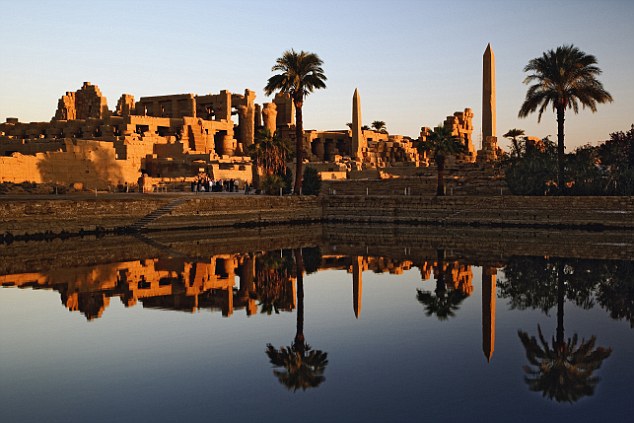
Breathtaking: The Karnak complex in Luxor includes the largest temple in the world
This reluctance is understandable – with Egyptians losing their lives in an ongoing struggle, taking a holiday in the country seems inappropriate. Yet for Egypt to enjoy economic recovery, tourists are vital. At the ancient sites, the lack of visitors is evident at once. Where once 50 buses set off every morning for the spectacular temple of Abu Simbel, now only five do. At Luxor, ranks of river cruisers remain idle.
For the souvenir-sellers around the monuments, it’s a disaster. More than 80 per cent of employment in the Nile Valley is associated with tourism, and for every man shouting to undercut the next, there is an extended family at home relying on his wage. Our guide Ahmed had worked very little over the past year.
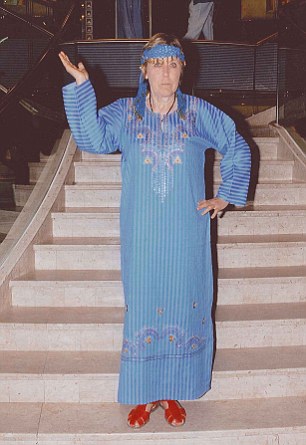
Local colour: Elinor in her Egyptian robes
Several years ago I went up Mount
Sinai to visit the monastery built on the site where Moses is supposed
to have seen the burning bush. There was such a crush of Japanese
tourists that I didn’t even realise I had passed the spot. But this
time, I was able to stand at Tutankhamun’s burial chamber with only two
other people.
Luxor, where my stepsister and I
started our Nile cruise, has the largest temple in the world at Karnak –
it could accommodate ten cathedrals and each stone block took 50 people
to drag up from the river. The scale is truly breathtaking.
Most of what we can see today was built 3,500 years ago but was buried for centuries. Originally, there was a 1½-mile avenue of sphinxes between Karnak and the Luxor temple which Ahmed said was a kind of honeymoon retreat – this was where male and female gods met once a year. The aim is to eventually reinstate the entire avenue, although work has only just resumed.
At every site, Ahmed dazzled us with facts before we were given a few minutes on our own, to gaze in awe at what were the most extraordinary feats of engineering given the technology (or lack of it) at the time.
Before leaving Luxor, we drove to the West Bank and the Valley of the Kings, where the pharaohs built their tombs to store their mummified bodies so their souls could be reunited with them in the afterlife. The valley is dotted with tombs, most of which get barely a mention in any guidebook.
We saw three of them, the most spectacular that of Rameses III: the corridor to the burial chamber was lined with texts from the guides to the underworld, written vertically in hieroglyphics and brought to life with pictures of the birds and animals he wanted to see in the afterlife. In the chamber itself, the colours were amazingly well preserved (photographs are not allowed in case flash damages them). By contrast, Tutankhamun’s tomb was less lavish, but it’s still worth travelling across the world to see it.
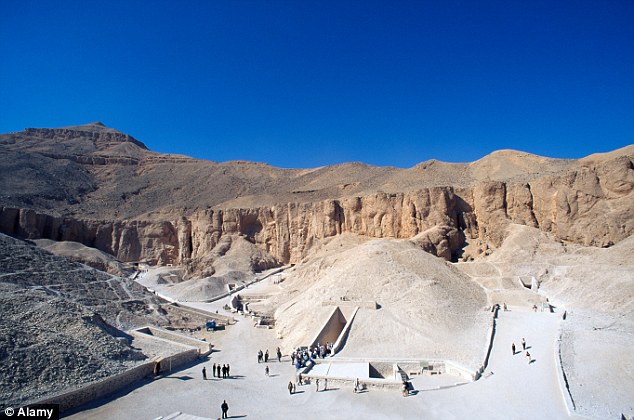
Spectacular: The Valley of the Kings is dotted with tombs the pharaohs built to store their mummified bodies
Back on the boat that night, kitsch took over from culture as we all dressed up in robes to dance. To my amazement, I found myself belly-dancing. A rather sedate party of bridge players abandoned their inhibitions too.
Our vessel, Royal Viking, was comfortable without being luxurious, and the food mostly delicious. At times, I felt like a bird in a golden cage surrounded by hungry starlings. One lunchtime, as we headed through a lock, boys on nearby boats peered at us and implored us to buy the long, flowing robes that most Egyptians still wear.
Vendors can be a nuisance but they have a living to make, and our guide instructed us on how to bargain.
On the way down the Nile we stopped at more temples, including the mighty Kom Ombo. By then were almost beginning to take the size of the vast buildings for granted, though they would dwarf most European remains of the same period.
What stuck in my mind, as our Chancellor was delivering his Budget at Westminster, was how the ancient Egyptian officials used a well to predict the tax revenues for the year ahead. If the well water rose above a certain level, they knew it would be a good year for agriculture and they could raise taxes; if the level fell, they had to cut back.
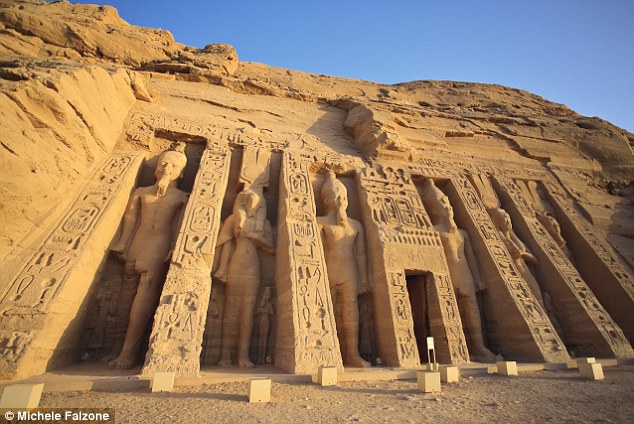
Magnificent: The colossal statues at Abu Simbel were built to intimidate invaders in the 12th Century BC
Sailing between the various stops during the day was wonderfully calming, and I loved finding a shady spot on the boat and just looking out over the placid waters of the Nile.
By contrast Aswan, home of the famous dam, was a noisy cauldron of a city, with mud-brick shacks piled on top of each other alongside half-built blocks of flats. Everywhere donkeys pulled carts between the cars.
Don’t miss the excursions, though. We took a boat out to Philae, the former home of the Temple of Isis. In a painstaking operation in the 1970s, the temple was moved to a higher site on the nearby island of Agilika to stop it being flooded after the dam was constructed.
My last excursion was an optional extra which cost £80 and meant getting up at 3am to drive across the desert to Abu Simbel. Technically it is not one of the wonders of the world, but if an eighth were to be added, it would surely be this.
After walking around a huge mound, I suddenly saw colossal statues gazing out over Lake Nasser like gigantic sentinels. They were built to intimidate invaders in the 12th Century BC, and like Philae, they were moved to safety in the last century. They are familiar from a dozen movies, but what I didn’t realise was that behind those great statues are magnificent temples.
Our trip ended with a slow cruise back to Luxor. I had my reservations about a cruise beforehand because I thought it might be a tame way to see a country. But I was wrong – it was a wonderful way to see an extraordinary country.
Share or comment on this article
-
 Emma Watson ‘unmasks’ to reveal Sofia Vergara underneath
-
 Is this the worst wheel of fortune contestant ever?
-
 Baby smoking weed posted on Vine
-
 William and Kate bowl each other over with a game of cricket
-
 Cliven Bundy supporters tased in violent standoff with feds
-
 Prince William and Kate sample New Zealand wine
-
 Meet Ambam the gorilla who walks like a man
-
 Singing priest becomes internet sensation after wedding…
-
 The Royal Couple tour Christchurch and play cricket
-
 CT mansion became the most expensive home sold in US
-
 The Duke and Duchess of Cambridge arrive in Dunedin
-
 Matt Smith’s video message to four-year-old Jack Robinson
-
 More nudists in Munich: German city gives nude sunbathing…
-
 The REAL reason airplane food tastes so bad (and it has…
-
 The world’s most terrifying roller coaster? Record-breaking…
-
 Is this the most hated airline in the US? Spirit tops the…
-
 Mother claims airline staff ‘abandoned’ her 12-year-old…
-
 William and Kate’s white-knuckle joy ride: Royal couple are…
-
 When Spider-Man met Mickey Mouse: Andrew Garfield and Emma…
-
 You can leave your top on: Southend funfair bans…
-
 Islands on the edge of the world: Sarfraz Manzoor and his…
-
 Dom Joly’s 10-day Italian detox: Jet-washed, starved and…
-
 Groundhog holidays! 80% of Brits return to the same resort…
-
 The Nile needs you! It’s a great time to book a river cruise…

Comments (7)
Share what you think
-
Newest -
Oldest -
Best rated -
Worst rated
The comments below have not been moderated.
Mel,
London,
3 hours ago
I went there ten years ago and the sights were utterly breathtaking, but so was the poverty. Such a shame and even ten years ago I felt very nervous and unsafe as there were men walking around openly carrying guns
Tom Skerritt,
Kensington Circle, United Kingdom,
3 hours ago
I’ve always wanted to get kidnapped while on holiday.
awaywithpixie,
Brisbane,
8 hours ago
We were there during the elections in January 2012. The number of empty boats moored in the Nile was heartbreaking. This country’s economy was 80% reliant on tourism. It was already faltering then. Five times the number of vendors would hassle you than normal. But there are truly some breathtaking sights. We were a part of a guided tour – we didn’t dare go anywhere without our tour group and guide – Cairo was just too crazy. We did spend a whole day driving the Sinai to avoid ‘men with guns’ on a road, but I didn’t feel unsafe. It was beautiful, but I worry that somehow, in the madness, it could all be destroyed. The poverty is appalling, but the experience is phenomenal.

seen it before,
wales, United Kingdom,
1 day ago
There year and half ago. Should be paradise on earth, but it is a madhouse. Dare not venture out of the hotel on your own. Go to anywhere but Egypt. Such a shame because the ancient wonders are spellbinding.
TGWS,
London, United Kingdom,
3 hours ago
tangerineturn,
Oswestry, United Kingdom,
1 day ago
I was on this trip and I wholeheartedly agree with Elinor. It was a fabulous trip which was both relaxing and informative, but the poverty caused by the collapse in tourism is heartbreaking. If you have the time and the funds, do go on a Nile cruise and help the country to get back on its feet.
Sue
David,
Warsaw, Poland,
1 day ago
The locals just love tourists … as targets to shoot at.
The views expressed in the contents above are those of our users and do not necessarily reflect the views of MailOnline.
 Who is this week’s top commenter?
Find out now
Leave a Reply