Caribbean resorts label stinking seaweed ‘disaster’ as tourists cancel holidays
- Seaweed is known as sargassum and attracts biting sand fleas
- Tobago officials have called it a ‘natural disaster’ as tourists steer clear
- Reportedly the seaweed has piled up as high as 10ft on beaches
John Hutchinson for MailOnline
and
Associated Press
20
View
comments
Decaying seaweed washing up on the Caribbean coast that smells like rotten eggs has been labelled a ‘natural disaster’ after tourists cancelled their holidays because of it.
The picture-perfect beaches and turquoise waters that people expect on their visits to the Caribbean are increasingly being fouled by mats of seaweed that attract biting sand fleas.
Clumps of the brownish seaweed known as sargassum have long washed up on Caribbean coastlines, but researchers say the algae blooms have exploded in extent and frequency in recent years.
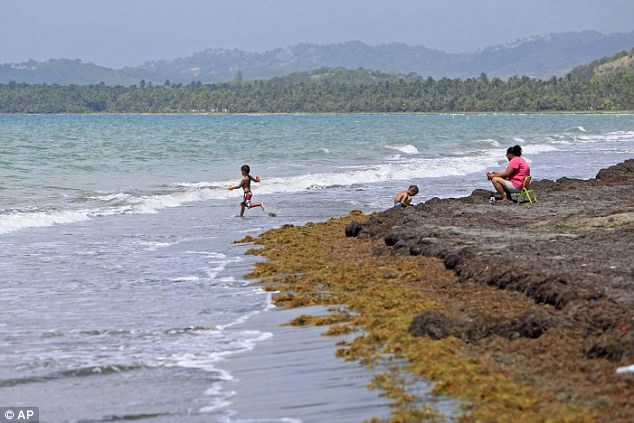
Children play as their mother keeps an eye on them at a beach heavily covered with seaweed in the east coast town of Humacao, Puerto Rico
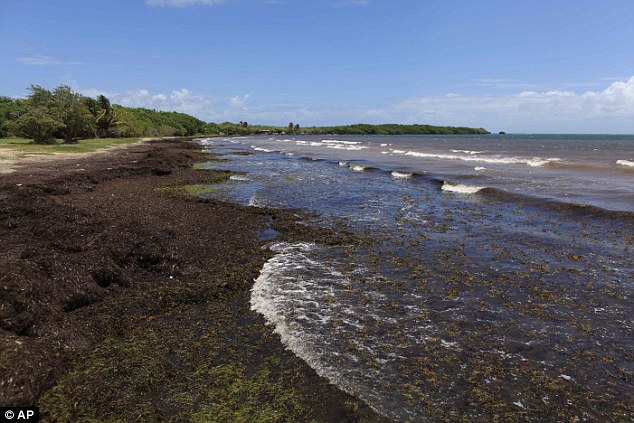
Large quantities of seaweed blanket the beach in the east coastPlaya Los Machos in Ceiba, Puerto Rico
The 2015 seaweed invasion appears to be a bumper crop, with a number of shorelines so severely hit that some tourists have canceled summer trips and lawmakers on Tobago have termed it a ‘natural disaster.’
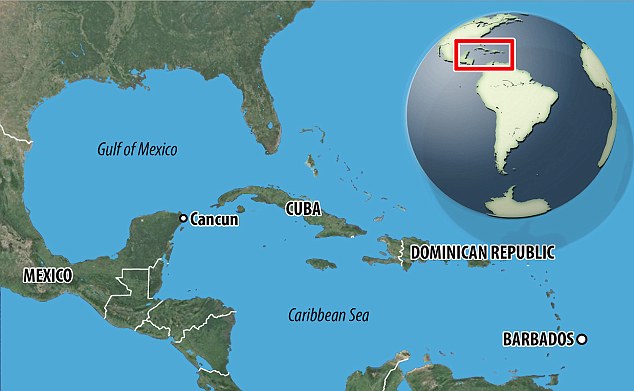
From the Dominican Republic in the north, to Barbados in the east, and Mexico’s Caribbean resorts to the west, officials are authorizing emergency money to fund cleanup efforts and clear stinking mounds of seaweed that in some cases have piled up nearly 10 feet high on beaches, choked scenic coves and cut off moored boats.
-
 US government hid report showing that TWO FIFTHS of air…
 What were they thinking? A loaded 9mm handgun, a sickle and…


With the start of the region’s high tourism season a few months away, some officials are calling for an emergency meeting of the 15-nation Caribbean Community, worried that the worsening seaweed influx could become a chronic dilemma for the globe’s most tourism-dependent region.
‘This has been the worst year we’ve seen so far. We really need to have a regional effort on this because this unsightly seaweed could end up affecting the image of the Caribbean,’ said Christopher James, chairman of the Tobago Hotel and Tourism Association.
There are various ideas about what is causing the seaweed boom that scientists say started in 2011, including warming ocean temperatures and changes in the ocean currents due to climate change. Some researchers believe it is primarily due to increased land-based nutrients and pollutants washing into the water, including nitrogen-heavy fertilizers and sewage waste that fuel the blooms.
The stinking seaweed has blighted the Caribbean coastline, putting off tourists
Brian Lapointe, a sargassum expert at Florida Atlantic University, says that while the sargassum washing up in normal amounts has long been good for the Caribbean, severe influxes like those seen lately are ‘harmful algal blooms’ because they can cause fish kills, beach fouling, tourism losses and even coastal dead zones.
‘Considering that these events have been happening since 2011, this could be the ‘new normal.’ Time will tell,’ Lapointe said by email.
The mats of drifting sargassum covered with berry-like sacs have become so numerous in the Caribbean Sea and the Atlantic Ocean they are even drifting as far away as to West Africa, where they’ve been piling up fast in Sierre Leone and Ghana.
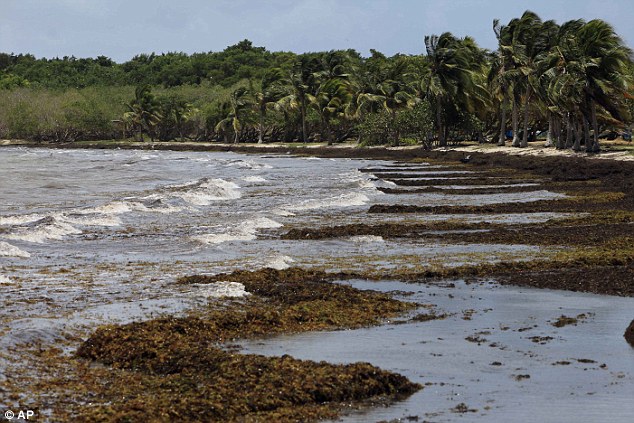
The 2015 seaweed invasion appears to be a bumper crop, with a number of shorelines so severely hit that some tourists have canceled summer trips and lawmakers on Tobago have termed it a ‘natural disaster’. Pictured is a beach in Puerto Rico
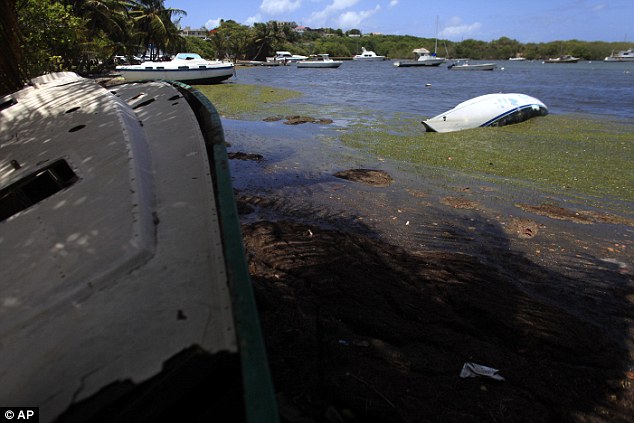
There are various ideas about what is causing the seaweed boom that scientists say started in 2011, including warming ocean temperatures and changes in the ocean currents
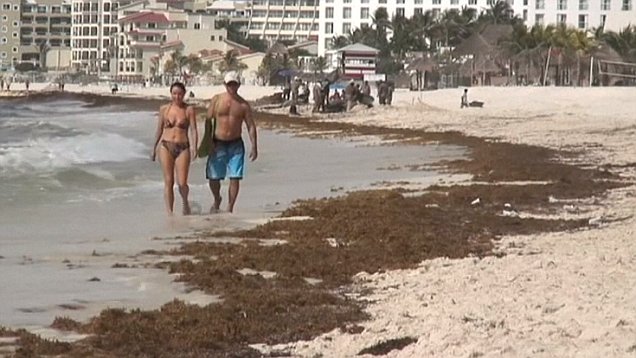
Sargassum, which gets its name from the Portuguese word for grape, is a floating brownish algae that generally blooms in the Sargasso Sea, a 2 million-square-mile body of warm water in the North Atlantic that is a major habitat and nursery for numerous marine species.
Like coral reefs, the algae mats are critical habitats and mahi-mahi, tuna, billfish, eels, shrimp, crabs and sea turtles all use the algae to spawn, feed or hide from predators.
But some scientists believe the sargassum besieging a growing number of beaches may actually be due to blooms in the Atlantic’s equatorial region, perhaps because of a high flow of nutrients from South America’s Amazon and Orinoco Rivers mixing with warmer ocean temperatures.
‘We think this is an ongoing equatorial regional event and our research has found no direct connection with the Sargasso Sea,’ said Jim Franks, senior research scientist at the University of Southern Mississippi’s Gulf Coast Research Laboratory.
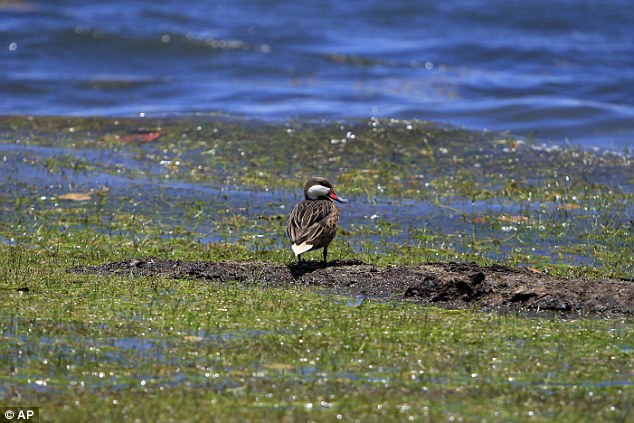
A white-cheeked pintail duck stands over a heavily seaweed covered beach in the east coast town of Fajardo, Puerto Rico
Whatever the reason, the massive sargassum flow is becoming a major challenge for tourism-dependent countries. In large doses, the algae harms coastal environments, even causing the deaths of endangered sea turtle hatchlings after they wriggle out of the sand where their eggs were buried. Cleanup efforts by work crews may also worsen beach erosion.
‘We have heard reports of recently hatched sea turtles getting caught in the seaweed. If removal of seaweed involves large machinery that will also obviously cause impacts to the beaches and the ecosystems there,’ said Faith Bulger, program officer at the Washington-based Sargasso Sea Commission.
Mexican authorities recently said they will spend about $9.1 million and hire 4,600 temporary workers to clean up seaweed mounds accumulating along that country’s Caribbean coast. Part of the money will be used to test whether the sargassum can be collected at sea before it reaches shore.
Some tourists in hard-hit areas are trying to prevent their summer vacations from being ruined by the stinking algae.
‘The smell of seaweed is terrible, but I’m enjoying the sun,’ German tourist Oliver Pahlke said during a visit to Cancun, Mexico.
Sitting at a picnic table on the south coast of Barbados, Canadian vacationer Anne Alma said reports of the rotting seaweed mounds she’d heard from friends did not dissuade her from visiting the Eastern Caribbean island.
‘I just wonder where the seaweed is going to go,’ the Toronto resident said one recent morning, watching more of mats drift to shore even after crews had already trucked away big piles to use as mulch and fertilizers.
Share or comment on this article
-
 Spooky puppet that ‘choked’ owner caught moving on camera
-
 Rosie apologizes to Kelly twice for being ‘overly sensitive’
-
 Diver posts second stunning encounter with 20-ft Great White
-
 Police release video ‘showing Tyrone Harris holding gun’
-
 Whale breaches next to boat allowing fisherman to remove…
-
 Eight-year-old Angelina Jordan shows off incredible voice
-
 Geraldine Bazan escapes serious injury in cliff accident
-
 Cop body cam footage shows four-year-old using breathalyzer
-
 Trump: Sanders was so weak dealing with Black Lives…
-
 Unbelievable footage shows massive explosion in China
-
 Astonishing video shows herd of cows get mesmerised by music
-
 Golden retriever lends a paw helping a puppy down the slide
-
 Say cheese! Former cruise ship photographer reveals…
-
 Airline announces it will weigh PASSENGERS before…
-
 Is this the most entertaining flight attendant ever?…
-
 Traveller, 31, earns $1MILLION and finds a glamorous…
-
 Plane passengers thrown from their seats and left covered in…
-
 Inches from death: Daredevils take on 30ft waves which crash…
-
 Bad call: Teenage tourist caught stealing roof tile from…
-
 What REALLY happens to your luggage at the airport:…
-
 Disabled passenger humiliated by British Airways staff when…
-
 Holiday nightmare as seven family members are treated in…
-
 You’ll be in Awe when you see this loch and the 19 other…
-
 The Glories of Secret Britain: 20 unsung but fabulous…

Comments (20)
Share what you think
-
Newest -
Oldest -
Best rated -
Worst rated
The comments below have not been moderated.
The views expressed in the contents above are those of our users and do not necessarily reflect the views of MailOnline.
 Who is this week’s top commenter?
Find out now
Leave a Reply