This is how to ruin your cruise and lose $2,753 at the same time
Looking for a quick and easy way to ruin your cruise? Just show up at the dock with the wrong travel documents. Alicia Ares and her fiancé recently did just that. As a result, the couple was denied boarding Royal Caribbean’s Empress of the Seas. And their tropical maritime dreams suddenly morphed into an express road trip back home.
Now, Ares is asking if Royal Caribbean owes them a replacement for their ruined cruise.
This tale serves as a grim warning to all travelers currently busy making summer plans: Check your required documentation. Then double-check it. Because if you show up for embarkation with the wrong travel documents to cruise to any country on your itinerary, you won’t be sailing. And the harshest part of this scenario is that the cruise line won’t owe you a penny for your trouble.
Trying to cruise with the wrong travel documents
Ares and her fiancé decided to spend last Thanksgiving on a Caribbean cruise. They selected Royal Caribbean’s week-long “Best of Cuba.” The itinerary would take the couple to Grand Cayman and two ports of call in Cuba.

This cruise would be a special one for the couple since Ares’ fiancé, Jorge, was born in Cuba. Now a U.S. citizen, he had not returned to the island since he left over 50 years ago. And today he still hasn’t, but I’ll get to why in a moment.
Happily planning their getaway and booking a variety of shore excursions, the couple made sure that their U.S. passports were valid.
Royal Caribbean sent the duo an abundance of information about Cuba. This pre-cruise package also included information about the required documents a U.S. citizen would need for the trip. And Ares says that they carefully reviewed it all.
“Royal Caribbean explained that on the day of the cruise, we would need to buy a Cuban visa,” Ares recalled. “That visa is required to be able to board the ship.”
Everything seemed simple enough.
On the day the cruise was set to sail, the couple excitedly headed to the port in Miami. As frequent cruisers, they assumed it would be smooth sailing from there. They had no inkling of the trouble that was about to completely ruin their cruise plans.
They were soon to be faced with an insurmountable problem: Jorge did not have the proper documents to travel to Cuba.
Royal Caribbean: “We’re sorry, but you’re being denied boarding”
“When we arrived at the port, there were two lines for check-in,” Ares remembered. “One for U.S. Citizens born in the United States and one for U.S. citizens born in Cuba.”
Confused but still not alarmed, Jorge and Ares got into their respective lines. When Jorge reached the front of his line, he was asked to produce his visa. He explained that he was in line to buy the visa.
With growing disbelief, Jorge listened as the Royal Caribbean representative explained why he would be denied boarding.
Cuba requires all U.S. citizens who were born in Cuba, but who came to the United States before 1971, to have a special HE-11 visa. Passengers can’t purchase this visa at the cruise terminal. A passenger who falls into this category must apply ahead of time for the document.
The Cuban émigrés who left the country prior to 1971 can travel to Cuba with foreign passport making the application at the consular office of a single door room called HE-11.
In order to enter Cuba, the Cuban émigré should present an accreditation document of residence in a foreign country together with the authorization. (from the Cuban consulate webpage)
This moment was the first that the duo had heard of the unique travel document required for Jorge to cruise to Cuba. But it put an end to all their Thanksgiving plans. It appeared their cruise was officially ruined.
Is there any way to save this cruise?
The couple was desperate to find some solution that didn’t include the loss of the entire cruise. They asked the crew members to reconsider the decision.
“We even offered to stay on board the ship during all of the stops in Cuba,” Ares told me. “But the crew members told us that the Cuban government would not allow it.”
Royal Caribbean’s response isn’t surprising. We know from past cases that if a passenger doesn’t possess the required documentation for any part of their itinerary, they will be denied boarding.
- This is how they got removed from their cruise (no refund included)
- No, a printout from Ancestry com is not valid ID to cruise to Canada
Cruise lines don’t set these requirements, and they can be fined for bringing a passenger to a foreign country without the proper travel documentation.
Asking Royal Caribbean to replace the ruined cruise
Once home, Ares says that she sent a registered letter to the CEO of Royal Caribbean. In her letter, she asked that the cruise line replace the ruined cruise. She reasoned that the company should have informed her fiancé of his particular requirements.
“Before the cruise, we filled out forms online, as requested, that clearly indicated that he was born in Cuba,” Ares complained. “Yet no information was given to us [about Jorge’s special circumstance]. And there is nothing on the website about this [H-11 visa requirement.]”
Royal Caribbean declined to provide the couple with a new cruise. And that’s when Ares contacted the Elliott Advocacy team.
Does Royal Caribbean alert Cuban-born passengers of the special visa requirements?
I read through Ares’ sad recounting of this cruise fiasco and noted some critical information that the couple had overlooked.
On several pages of their pre-cruise information was a link to Royal Caribbean’s ‘Cruising to Cuba’ FAQs.
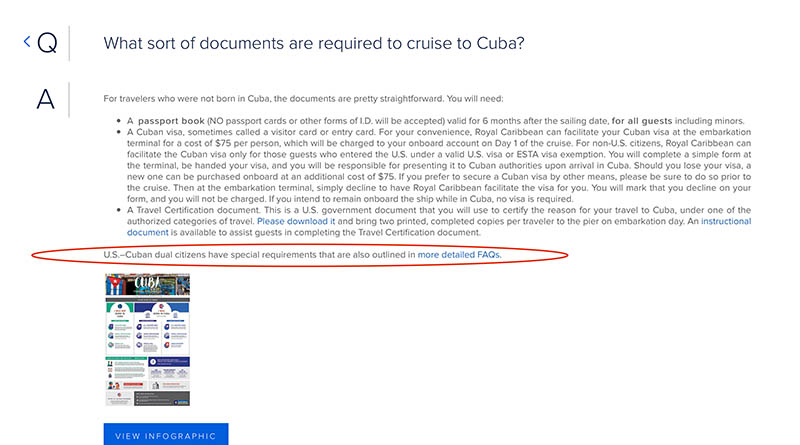
When I clicked on the “more detailed FAQs,” there was all the information Jorge needed to know about his required travel documents.
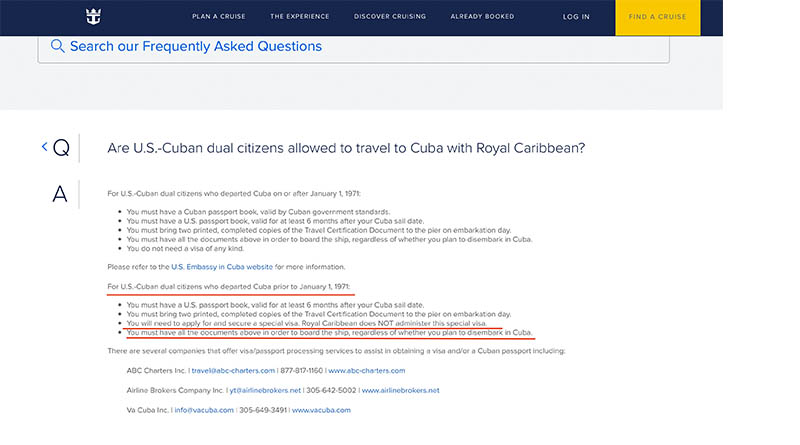
Unfortunately, it appeared that Ares and Jorge had never clicked on any of the links provided by Royal Caribbean. That was a mistake.
It is always the travelers’ responsibility to know and possess their required travel documents
Royal Caribbean, like every other cruise line, makes it clear in its terms and conditions that the passenger is responsible for having their required travel documents. If the passenger is denied boarding for having incomplete or incorrect travel documents, no refund is owed.
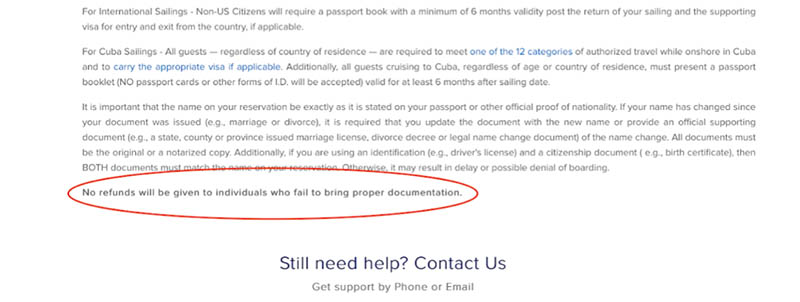
And while at first glance it would seem that a passenger-friendly approach would have the cruise line conduct these documentation checks ahead of time, that isn’t possible. Travel document requirements can change frequently and so these checks must happen on the day of departure. In fact, the situation in Cuba and the requirements for entry are quite fluid.
Check with the U.S. State Department before travel
For these reasons, we recommend that U.S. citizens always check with the Department of State before travel. If Jorge had done so, the couple might have chosen a different cruise. Travel to Cuba as a Cuban-born U.S. citizen can have unknown implications according to the state department.
Cuba does not recognize the U.S. nationality of Cuban-born U.S. citizens. The Cuban government requires Cuban dual nationals to enter and depart Cuba using Cuban passports. Cuban-born U.S. citizens will be treated as Cuban citizens and may be subject to restrictions and obligations. (from the U.S. State Department)
But the couple had not checked with the State Department about their travel to Cuba.
After reviewing all parts of Ares’ case, I explained why our team would have no basis to ask the cruise line to replace the ruined cruise. However, I suggested that she might use our company contacts for Royal Caribbean and make a short, polite request for a small goodwill gesture consideration.
Ares says that’s what she intends to do.
How you can avoid showing up with the wrong travel documents
Our advocacy team receives almost daily requests for help from consumers whose vacation plans ended abruptly at the airport or cruise terminal. It’s an unpleasant task to explain why we won’t be able to help them in their quest for a refund. But we continue to tell these sad tales in hopes that other travelers can avoid the financial and emotional toll these situations can take.
There are a few things you can do before your vacation is set to begin that can prevent you from ending up at the check-in counter with the wrong travel documents.
- Always check the U.S. State Department’s website for the required documentation for your intended destination. Don’t forget to check countries you might be transiting through as well as your primary destination. The ‘Before you go’ homepage is the best place to start your research on virtually any destination in the world.
- Visit the consulate or embassy webpage of the country or countries to which you plan to travel. Again, don’t overlook those countries you are transiting through.
Loading …
Leave a Reply